6.8-inch 9K
Monochrome LCD Screen
& Matching HDMI Driver Board
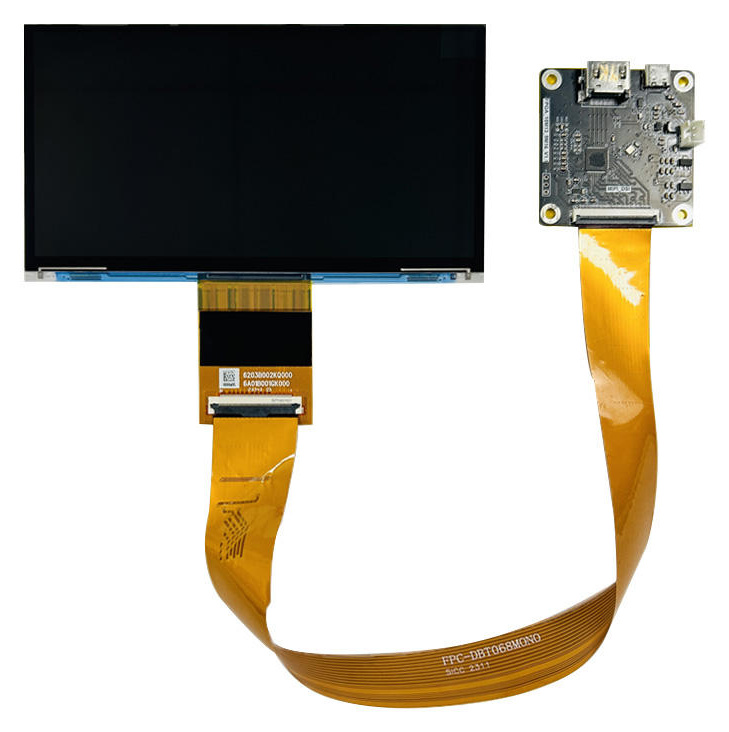
Build the display section of your resin 3D printer with a 6.8-inch 9K mono LCD and matching HDMI driver board options. Select the screen, board or both.
LCD & driver board
Choose one or both.
- LCD screen
- 6.8-inch 9K · 8520 × 4320 · MIPI
- HDMI driver board
- HDMI input · Panel-specific configuration
Screen and board quantities are quoted individually. Cable and power-supply requirements are confirmed with your configuration.
Raspberry Pi control
Build a Raspberry Pi exposure setup with a driver board configured for this 9K monochrome panel.
- Raspberry PiHDMI output
- Driver boardHDMI to MIPI
- 6.8-inch LCDMonochrome panel
The driver board connects the Pi’s HDMI output to the LCD’s MIPI interface. Confirm the board firmware, accepted input mode and image mapping for your Raspberry Pi model.
Tell us your Raspberry Pi modelHDMI cable & power
| Raspberry Pi model | Pi-side connector |
|---|---|
| Pi 4 Model B / Pi 5 | Micro HDMI |
| Pi 3 Model B / B+ | Full-size HDMI |
| Zero / Zero W / Zero 2 W | Mini HDMI |
Choose the other cable end to match the driver board’s HDMI socket. Use a suitable power supply for the Pi and the specified supply for the driver board; HDMI is the signal connection.
Display configuration
Raspberry Pi OS normally reads available HDMI modes from the driver board’s EDID. Use a board-supported resolution and refresh rate, then check image orientation and pixel mapping.
The panel’s 8520 × 4320 resolution does not define the Pi’s HDMI output mode. Request the board-specific display profile before testing exposure patterns.
Include your Pi model, OS version and required cables or power supplies in the inquiry. This setup uses an external HDMI driver board.
Raspberry Pi display guideSpecifications
Display
| Material model | DBM068M9K01 |
|---|---|
| Screen size | 6.8 inch |
| Display type | Monochrome TFT LCD |
| Resolution | 8520 × 4320 pixels |
| Pixel pitch | 18 × 18 µm |
Dimensions & interface
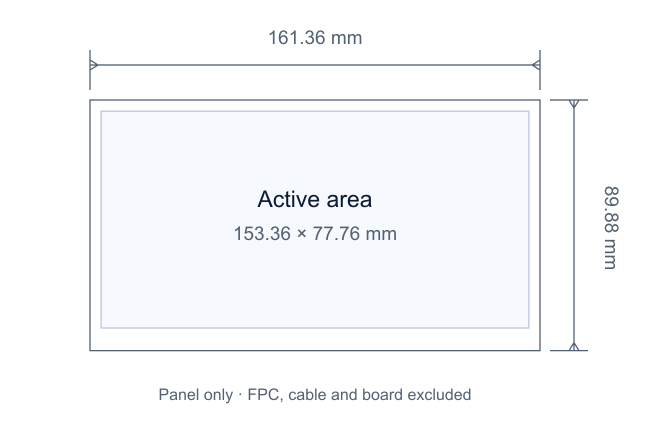
| Active area | 153.36 × 77.76 mm |
|---|---|
| Panel outline | 161.36 × 89.88 mm |
| Panel interface | Dual-port MIPI · 51 pins |
| Ordering options | LCD / Driver board / Both |
Technical details & ordering checks
The active area is 153.36 × 77.76 mm. The supplier’s technical table distinguishes a 161.36 × 86.31 mm CF-glass outline from the 161.36 × 89.88 mm panel outline. Allow additional space for the FPC, cable and driver board.
Dual-port, 8-lane MIPI D-PHY interface. Connector references differ between 50 and 51 pins; confirm the connector drawing, pin assignment and panel revision before ordering.
Confirm the operating temperature for your panel revision: references differ between 0–70 °C and −20–70 °C. Storage: −10–80 °C. Typical transmittance: 4% with polarizer at 405 nm. Minimum contrast: 300:1 under the specified 405 nm backlight. These panel measurements do not determine print speed or part accuracy.
Integration
Check the panel dimensions, connector and controller configuration for your system.
Mechanical fit
Allow space for the panel, external PCB and flexible cable. Compare the mounting opening and cable routing with your existing assembly.
51-pin MIPI connection
Match the connector drawing, contact orientation and dual-port signal assignment. The pin count needs confirmation against the final panel revision.
Board and host timing
The driver board must map your host signal to the panel’s required timing and monochrome image layout. Confirm the input mode and firmware before ordering.
FAQ
How should I handle and install the screen?
Follow your system’s assembly or service instructions for mounting, sealing and calibration.
- Disconnect power and keep the panel and connectors free of resin and debris.
- Open the connector latch before moving the cable. Avoid pulling or sharply bending the flexible circuit.
- Run the screen test, check image orientation, and configure exposure before printing.
Can I buy just the LCD?
Select LCD screen and leave HDMI driver board unchecked to request the screen only.
Can I buy just the driver board?
Select HDMI driver board and uncheck LCD screen to request a board-only quote. Include your panel code and controller requirements so the board version can be confirmed.
Is the driver board included with the LCD?
Select both components if you need a screen and board. The inquiry lists their quantities individually; included accessories are confirmed in the quote.
Will this work in any 6.8-inch 9K printer?
Please send the exact panel code and printer model. Mechanical fit, connector pin assignment, board configuration and firmware must all match.
Are cables and a power supply included?
List the accessories you need in the inquiry. Cable, adapter and power-supply inclusion is confirmed for the selected board and configuration.
Does the LCD accept HDMI directly?
The LCD uses MIPI. HDMI input requires a driver board configured for this panel. Its accepted host resolution and image mapping must be confirmed; the 9K panel designation does not establish the board’s accepted HDMI input resolution.
How do I connect a Raspberry Pi?
Connect the Pi’s HDMI output to a driver board configured for DBM068M9K01, then connect the board to the LCD through its matched FPC. Use the connector reference in the Raspberry Pi section and include your model, OS version and intended output mode in the inquiry. The bare LCD is not a direct connection to the Pi’s DSI port.
Building a resin 3D printer?
Tell us your mainboard or HDMI host, the LCD screen you need, and whether you want the screen, matching board or both. Include quantities so we can discuss your configuration before quotation.
Read the LCD and HDMI driver board guide →
Choose LCD & board options ↑